
I knew I needed to say no.
Not maybe. Not let me see how I feel later. I knew.
Since my fourth traumatic brain injury, my energy doesn’t work the way it used to. Cognitive fatigue can hit fast, and unfortunately, socializing uses some of that same limited battery.
I’ve learned this the annoying way.
Sometimes two days of doing things is fine. Four days can come with a bill I don’t get until later.
And my body is a very aggressive debt collector.
So there have been times when someone invited me somewhere and every sensible part of me knew the answer should be no.
Then guilt entered the chat.
Maybe I’m disappointing them.
Maybe I should make the effort.
Maybe I’m being difficult.
Maybe this is important.
Maybe I’ll be fine.
Maybe, maybe, maybe.
And suddenly the answer I knew was right for me started looking selfish.
So I said yes.
I’ve also done the other version: said yes when I had enough energy, then reached the day of the plans cognitively exhausted and realized I couldn’t go.
That one used to make me feel terrible.
I’d sit there trying to figure out how much explanation I owed the other person. Was cognitive fatigue a good enough reason? Was I really sick? Would they think I was unreliable?
Eventually, I had to have a rather ridiculous conversation with myself:
Karine, you’re sick. You don’t need to prepare a legal defense.
I could simply say, “I’m not feeling well. I can’t make it today.”
Because it was true.
But here’s the part that took me longer to understand:
Knowing that you want to say no doesn’t automatically make saying no feel safe, comfortable, or easy.
And feeling guilty about a no doesn’t necessarily mean the no was wrong.
Sometimes it means you’re doing something you’re not used to doing yet.
So why do we say yes when we want to say no?
Because the decision isn’t always as simple as:
Do I want to do this?
Sometimes there’s another question running quietly underneath it:
What will happen if I say no?
Will she be disappointed?
Will he think I’m selfish?
Will they stop asking me?
Will I look difficult?
Will I hurt someone’s feelings?
Will I need to explain myself?
Will this become a whole thing?
And suddenly, saying yes has a very attractive feature:
It makes the discomfort go away right now.
Someone asks.
You feel that little internal ugh, I really don’t want to.
But saying no means potentially disappointing someone, explaining yourself, tolerating awkwardness, or sitting with guilt.
So you say:
Sure.
Immediate relief.
Problem solved.
Except it isn’t.
You just moved the discomfort from now to later.
And Later You is going to be thrilled about this arrangement.
Sometimes the yes comes out before you’ve even asked yourself what you want
This is the part I find fascinating.
Someone asks:
“Can you help me with this?”
“Want to come Saturday?”
“Could you take care of this?”
And before you’ve checked your calendar, your energy, your actual desire to do it, or whether you’ve already promised yourself one blessed weekend without obligations:
“Sure!”
The yes is halfway out the door before you’ve even held the staff meeting.
Researchers studying compliance have found that people asking for something often underestimate how socially uncomfortable it can be for the other person to refuse. In other words, the person making the request may experience it as a simple question while the person answering is navigating a much more complicated social calculation. (Cornell eCommons)
That doesn’t mean every yes is people-pleasing.
Sometimes you genuinely want to help.
Sometimes you’d rather stay home in your pajamas watching television, but your friend needs you, and you consciously decide:
She’s important to me. I’m going.
That’s not self-abandonment.
That’s a choice.
The problem isn’t saying yes. The problem is losing access to your no.
A true yes and an automatic yes are not the same thing
This distinction matters because I don’t want to turn saying no into another ridiculous internet commandment.
You don’t need to decline everything.
You don’t need to “protect your peace” from anyone who mildly inconveniences you.
You don’t need to become the woman who spent 42 years saying yes to everything and now treats a request to pass the salt as a boundary violation.
We still live with other humans.
Sometimes we inconvenience ourselves for people we love.
Sometimes we help when we’d rather not.
Sometimes we compromise.
Sometimes generosity costs us something.
The question is whether you’re choosing the cost or automatically paying it.
Organizational psychologist Sunita Sah describes defiance not simply as refusal, but as acting according to your values when there’s pressure to do otherwise. Her work also distinguishes genuine consent from compliance: being able to say no matters to whether a yes is actually voluntary. (Cornell Alumni Network)
That’s much closer to what interests me.
Not:
How can I become better at saying no?
But:
How can I become better at knowing when I mean yes and when I mean no — and responding accordingly?
Because saying no just for the sake of saying no isn’t freedom either.
Choice is.
The uncomfortable feeling may be information — not an instruction
You know that moment.
Someone asks you for something.
Your stomach tightens.
Your brain starts negotiating.
I really don’t want to.
Then almost immediately:
But I should.
That internal friction is worth noticing.
Not obeying automatically.
Not diagnosing.
Just noticing.
Sah describes this kind of tension as an early stage in recognizing that what we actually want or value may be colliding with what we feel expected to do. (Cornell Alumni Network)
I like that framing because it gives discomfort a different job.
Discomfort doesn’t have to make the decision. It can simply tell you that there’s a decision here worth making consciously.
Maybe you still say yes.
Fine.
But now it’s your yes.
Guilt is especially convincing because it feels like evidence
This one has gotten me more than once.
You say no.
You feel guilty.
And your brain immediately presents Exhibit A:
See? You feel terrible. Obviously you’re doing something wrong.
Except emotions aren’t verdicts.
Guilt has an important social function. Research has long connected it with interpersonal relationships and our concern about how our behavior affects other people. (PubMed)
Which is useful.
I would personally prefer a society containing at least some people capable of feeling bad when they behave like assholes.
But the presence of guilt doesn’t automatically prove you’ve harmed someone.
You can feel guilty because you violated a value.
You can also feel guilty because you violated an expectation.
Those are not necessarily the same thing.
Maybe you’ve spent years being the available one.
The helpful one.
The one who doesn’t make things complicated.
The one who can squeeze it in.
The one who says, “It’s fine.”
Changing that pattern can feel wrong before it feels normal.
Sometimes guilt is telling you that you did something wrong. Sometimes it’s telling you that you did something differently.
Learning to tell the difference matters.

Ask a better question: What will this yes cost me?
I’ve learned this lesson the expensive way.
I’ve pushed myself through plans I knew were too much and needed more than a month to recover afterward.
A month.
For a yes I already suspected should have been a no.
That’s a hell of a price to pay for avoiding a few minutes of guilt.
My cost happened to be physical.
Yours might not be.
Maybe your yes costs you Saturday.
Maybe it costs you the evening you desperately needed alone.
Maybe it means staying two hours late because somebody else’s emergency mysteriously became your responsibility.
Maybe it’s lending money you can’t comfortably lose.
Maybe it’s another committee.
Another favor.
Another family obligation.
Another project.
Maybe you say yes and spend the next three days pissed off at the person who asked.
Which is interesting.
Because sometimes they didn’t actually do anything wrong.
They asked.
You answered.
And now you’re angry because they believed you.
Ouch.
I’ve done versions of that too.
This is one of the reasons boundaries can actually protect relationships rather than destroy them. Assertiveness is generally understood as expressing your own needs, rights or preferences while still respecting those of the other person — not dominating them, and not disappearing yourself. (PubMed Central (PMC))
A clear no can sometimes be considerably kinder than a resentful yes.
You don’t need a courtroom-worthy reason
This is where my imaginary legal defense comes back.
When saying no feels uncomfortable, we sometimes start building a case.
I can’t because…
And then come twelve supporting exhibits, three character witnesses and a PowerPoint presentation.
Because underneath all that explaining is sometimes a belief that:
My no becomes legitimate only when the other person agrees that my reason is good enough.
But if that’s the rule, they’re still making the decision.
You’re just submitting an application.
There are situations where context and explanation are appropriate, obviously. Relationships aren’t customer-service tickets.
But there’s a difference between sharing context because you want to and trying to make your no impossible to challenge.
The second one is exhausting.
And it rarely works anyway.
Someone determined to argue with your no can usually find an opening in a twelve-paragraph explanation.

Before you learn to say no, learn to stop saying yes so damn fast
This may be the most useful place to begin.
Not with some dramatic declaration.
Not with:
NO IS A COMPLETE SENTENCE!!!
Technically? Sure.
Emotionally, for someone who has spent decades smoothing everything over?
Congratulations. You just assigned calculus to someone who’s still trying to find the classroom.
Instead, practice creating space.
Researchers have found that part of the difficulty of refusing a request can simply be finding the words in the moment. In two experimental studies, giving people an explicit phrase they could use to decline made them feel freer to refuse — and, interestingly, freer in their decision to agree as well. (PubMed Central (PMC))
So before answering, borrow time.
Try:
“Let me check and get back to you.”
Or:
“I’m not sure yet. Can I let you know tomorrow?”
Or even:
“My first instinct is yes, but I’m trying to stop answering before I check my capacity. Let me get back to you.”
That tiny pause matters.
Because now there is finally room for a question we often skip:
What do I actually want?
Not:
What would make me look generous?
What answer will avoid awkwardness?
What would a “good daughter” do?
What would a “good friend” do?
What will make sure nobody is disappointed?
Just:
What do I want?
And then, if the answer is no, you can ask the next question:
Do I still consciously choose yes for a reason that matters to me?
Sometimes you will.
That’s important.
Maybe you don’t want to spend Sunday helping your sister move a sofa down three flights of stairs because you are not clinically insane.
But you love her.
She needs you.
And you decide the sore back and lost Sunday are worth it.
That’s a real yes.
You considered yourself and the relationship.
WWD isn’t interested in teaching women that self-respect means never inconveniencing themselves for anyone else.
We’re interested in something harder:
Not disappearing from your own decisions.
You may still screw this up
I certainly do.
That’s another thing I want to make clear.
Breaking a pattern doesn’t mean graduating into some magical state where you never repeat it.
Healing isn’t linear.
Sometimes you notice the loop before you say yes.
Sometimes you notice while you’re saying it.
Sometimes you notice two hours later.
Sometimes you’re already halfway through the damn thing thinking:
Ohhhhh. There it is.
That still counts.
Because awareness changes what becomes possible next time.
Maybe the progression looks like this:
You used to realize three days later.
Then three hours later.
Then three minutes later.
Eventually, you hear yourself about to say yes and pause.
Progress isn’t always “I never do this anymore.”
Sometimes it’s:
“I catch myself faster.”
And catching yourself faster gives you something incredibly valuable:
choice.

The question isn’t whether you’re allowed to say no
You are.
But intellectually knowing that probably isn’t the part you’re struggling with.
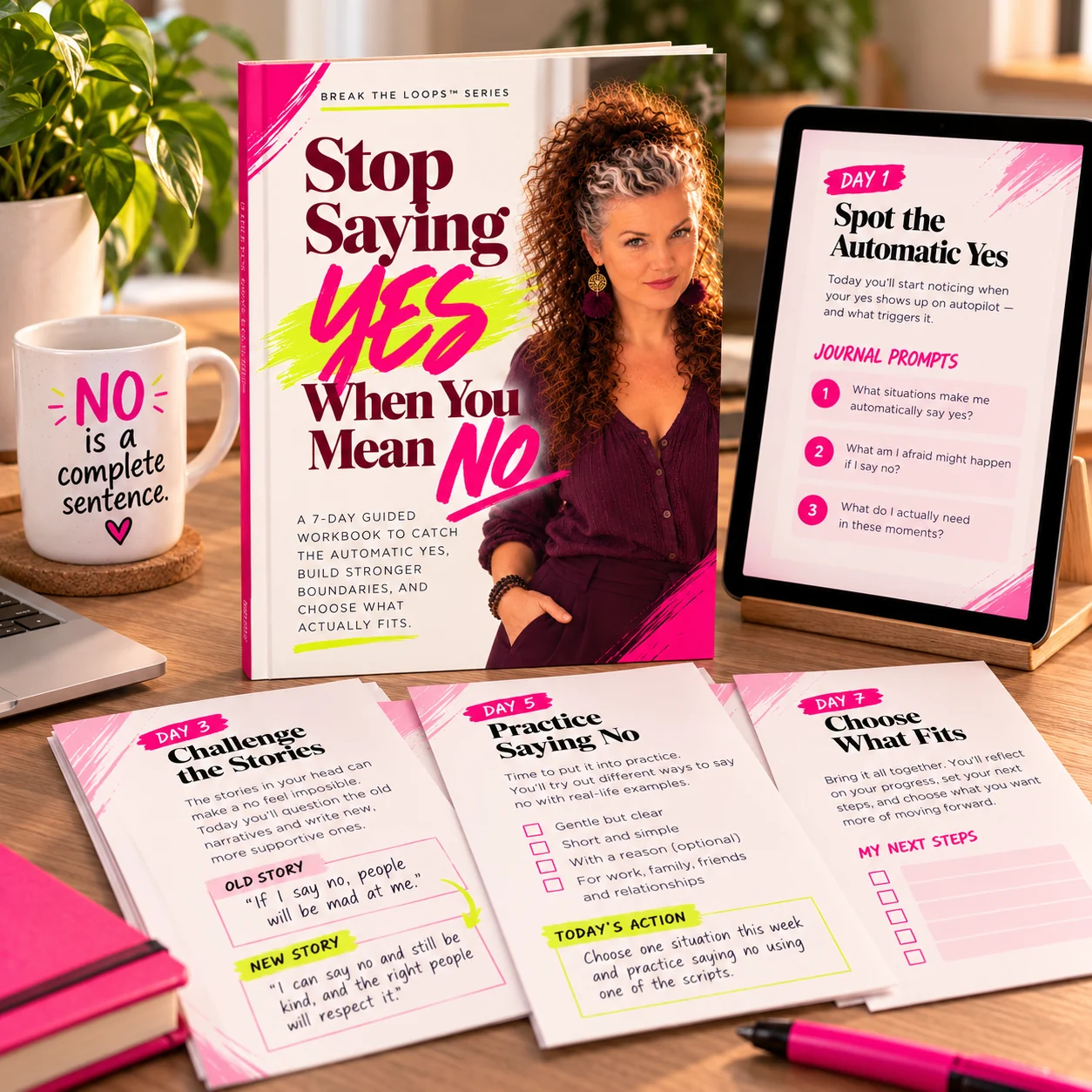
You can have “permission” to say no printed on a mug and still find yourself agreeing to organize Janet’s retirement party when you barely know Janet.
The more interesting questions are:
What happens inside me when I want to say no?
What am I afraid my no will mean?
What am I trying to avoid feeling?
What does my automatic yes cost me?
And how can I create enough space to choose instead of react?
That’s the loop.
And once you can see the loop, you can start interrupting it.